- Token Terminal
- Posts
- Tokenized stocks: from public equities to private markets
Tokenized stocks: from public equities to private markets
+ data & product updates
Each week in The Snapshot, we share data-driven insights, highlight new listings, and showcase our latest product updates.
Read on for the latest edition 👇

Across markets, the boundaries between public and private, TradFi and DeFi, are converging. Companies are staying private longer, the opportunity set in private markets is growing, and technological innovation is making both public and private assets more accessible to a broader set of investors. Tokenized stocks sit at the intersection of all three trends, bringing equity exposure onchain with 24/7 trading, fractional access, and DeFi composability.
For over two years after the first tokenized stocks launched in 2023, adoption was negligible. In 2025, xStocks and Ondo Global Markets brought tokenized public equities to scale, pushing the category past $1B in under a year.
Now the scope is expanding beyond public equities. PreStocks launched tokenized private equities on Solana, offering SPV-backed exposure to pre-IPO companies like Anthropic, OpenAI, and SpaceX onchain. Private equities remain a fraction of the total today, but they represent a structural expansion of what the category covers.
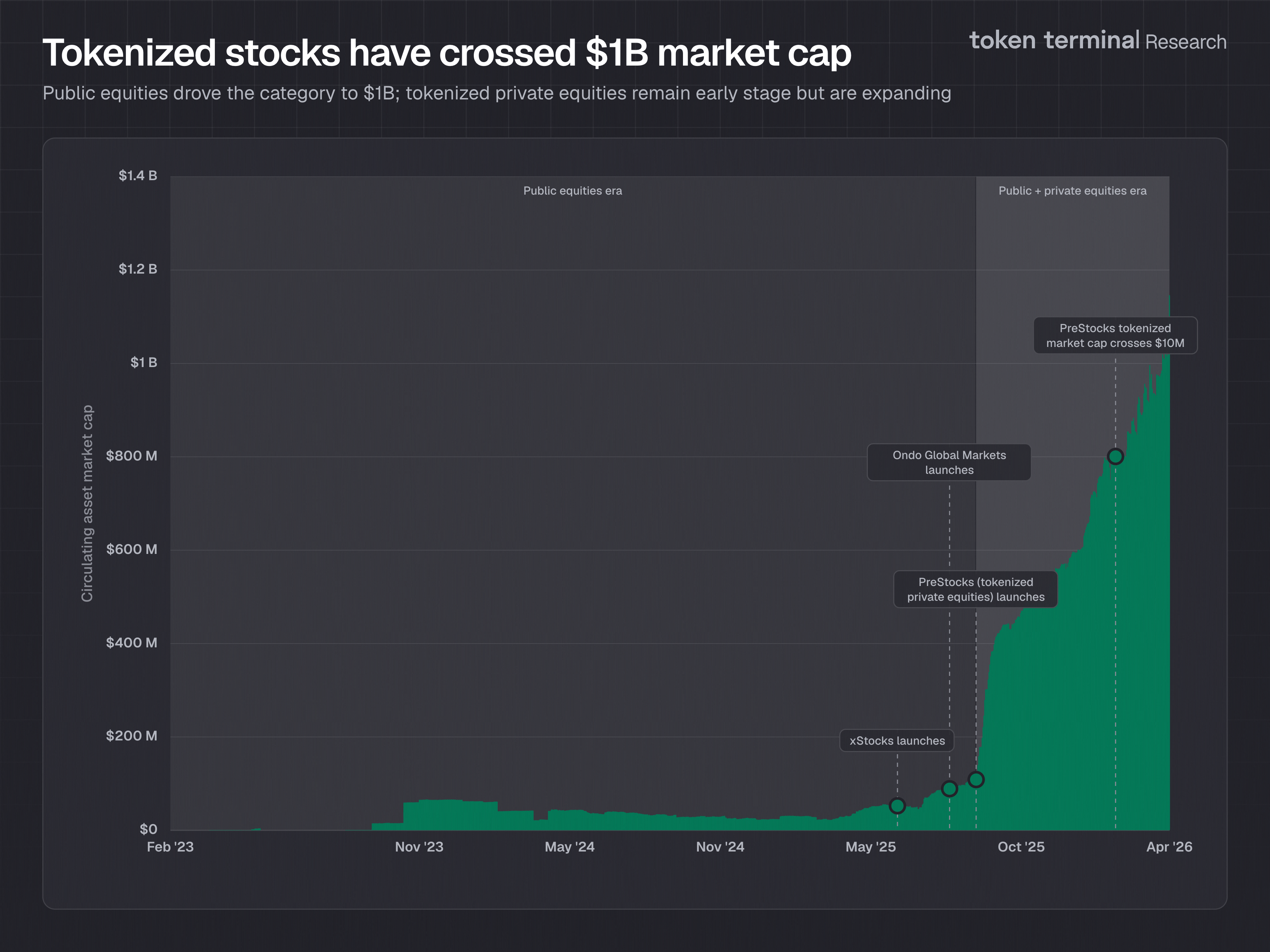
1) PreStocks brings private companies onchain
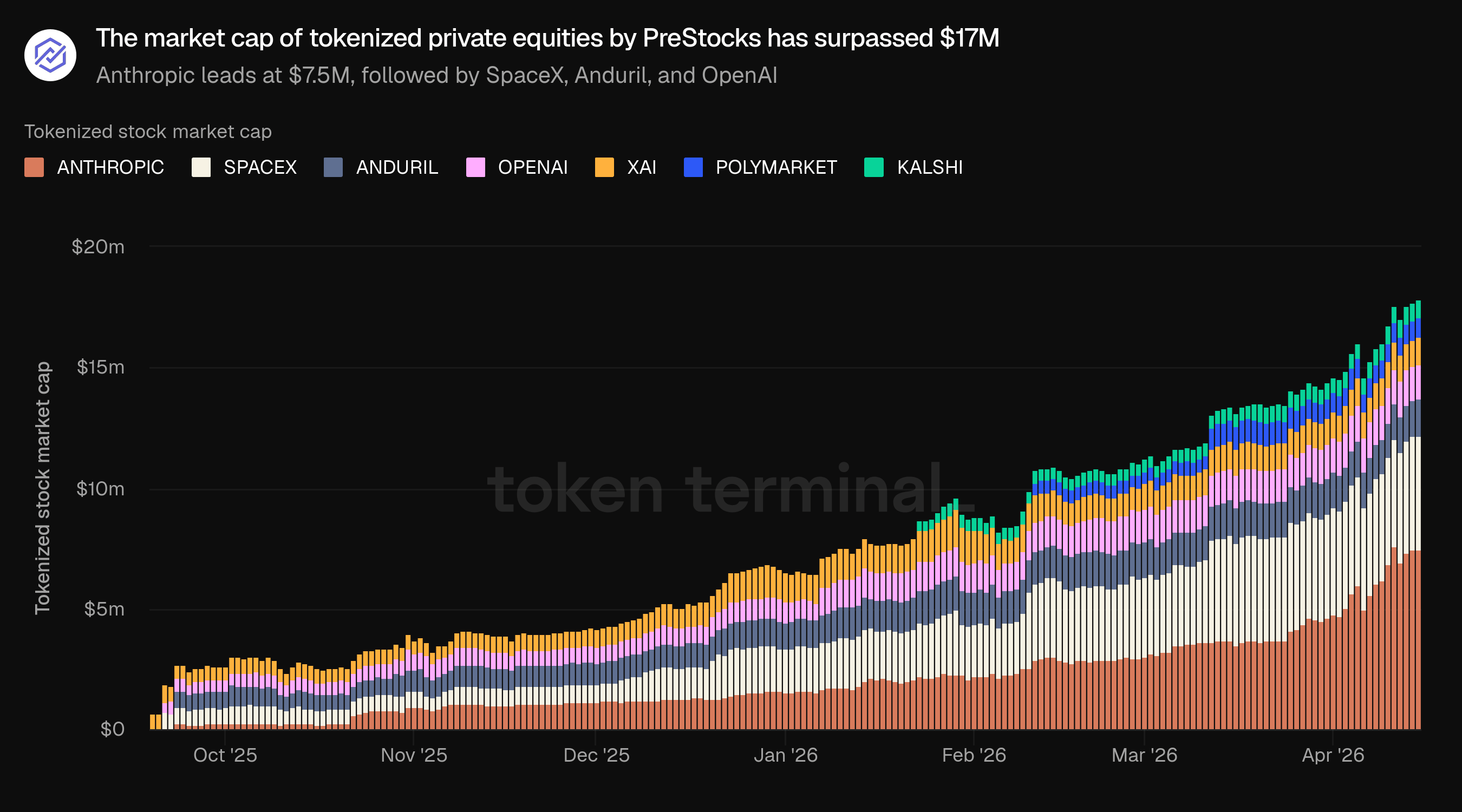
Tokenized private equities are a new asset class onchain, and early demand clusters around a handful of names. PreStocks issues SPV-backed tokens on Solana that track private company valuations. Market cap has grown from near-zero at launch to $17.8M, led by Anthropic ($7.5M), SpaceX ($4.7M), xAI ($1.1M), Anduril ($1.5M), and OpenAI ($1.4M).
Tokenization is closing a convenience gap in private markets. Traditional pre-IPO secondaries typically require large minimum investments and settle on much longer timelines. PreStocks offers fractional access from $0.01, 24/7 trading, and DeFi composability.
At $17.8M, PreStocks represents less than 2% of the total tokenized stock category, and structural risks remain. The underlying companies have not publicly endorsed the tokens being issued, and onchain prices can trade at significant premiums. Yet if private equity tokenization follows the curve of public equity tokenization, growth could accelerate and liquidity improve as more assets and platforms enter the category.
2) Tokenized SpaceX has the most demand onchain
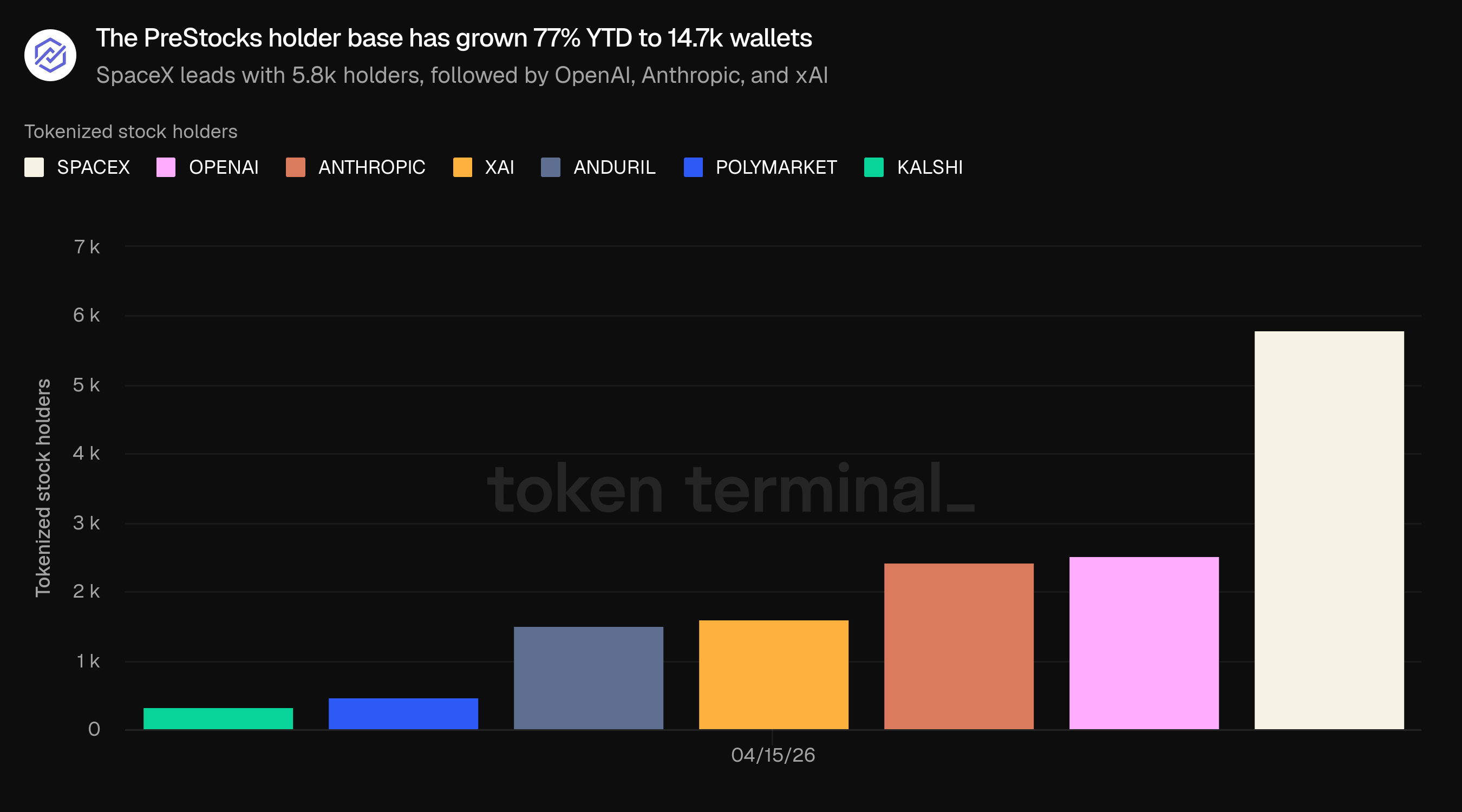
PreStocks now has over 14.7k unique holders, up from 8.3k at the start of 2026 (77% YTD). SpaceX leads individual asset holder count with roughly 5.5k wallets, followed by OpenAI and Anthropic at around 2.5k each. The growth is broad-based across assets, not concentrated in a single token.
The growth reflects a demand gap: retail investors want to share in the upside of companies that have historically been accessible only to private investors. The most valuable private companies in the world are worth trillions of dollars, but the appreciation from early-stage to IPO has been captured almost entirely by institutional investors. By bringing these names onchain with no minimums, PreStocks gives retail users a way to participate in the value creation happening in private markets before a public listing.
Broadening ownership could matter beyond just financial returns. Technologies like AI are reshaping industries, and public sentiment toward them may ultimately depend on whether ordinary people feel they have a stake in the outcome. If the only investors benefiting from AI's growth are large institutions, public support could erode. Tokenized private equities, by widening the ownership base, could help align incentives between the companies building transformative technology and the broader public affected by it.
3) The tokenized stock market is dominated by two issuers
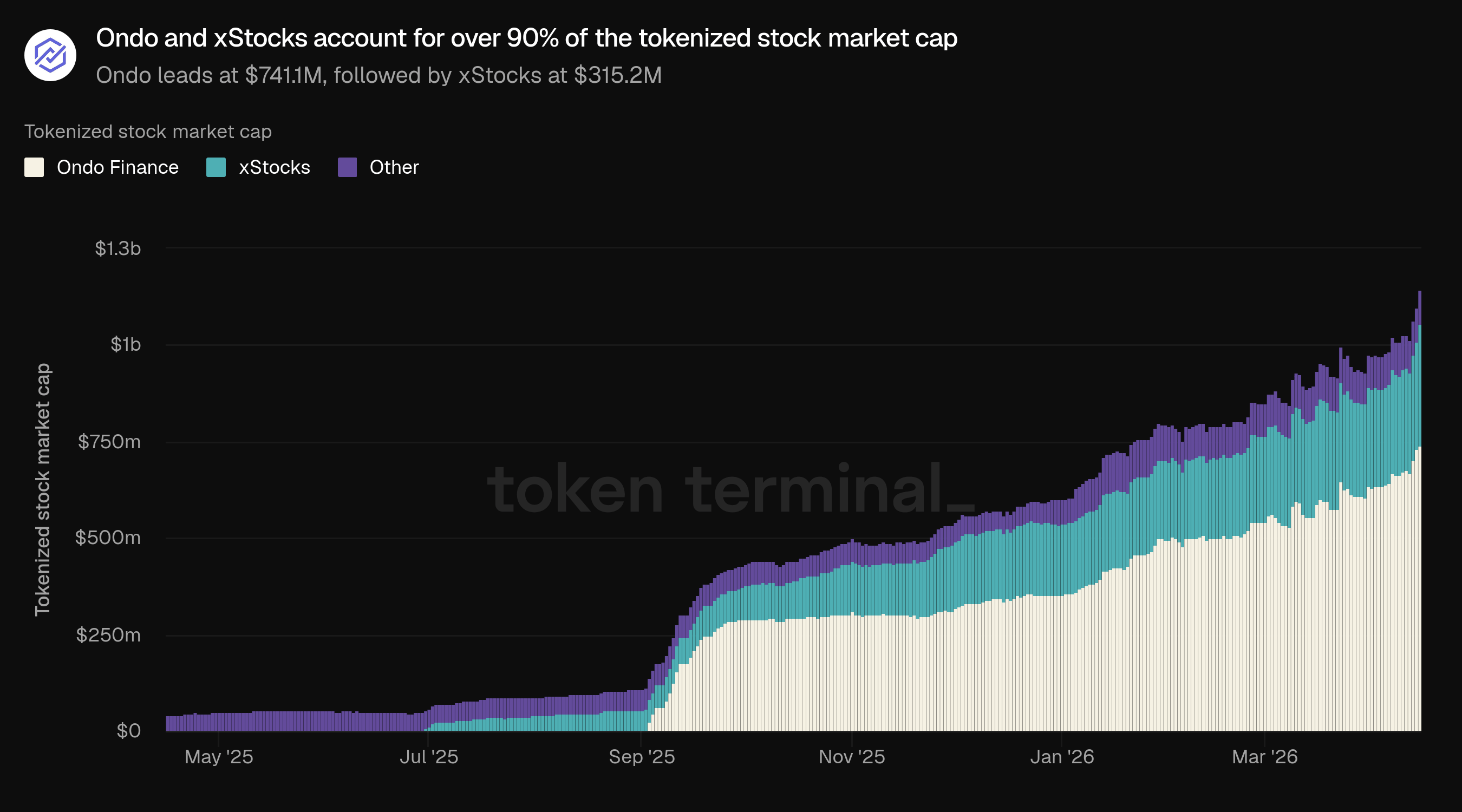
Ondo Finance and xStocks together account for over $1B of the market cap of tokenized stocks. Ondo leads at $741.1M, dominant on Ethereum ($440.1M) and BNB Chain ($283.2M). xStocks follows at $315.2M, dominant on Solana ($258.4M) with CEX distribution through Kraken and Bybit.
The "Other" segment is small but increasingly diverse. Superstate accounts for $25.6M. Robinhood has $19.1M on Arbitrum across more than 1,000 deployed tokens. PreStocks adds $17.8M in tokenized private equities. Dinari contributes $12.4M across Arbitrum, Ethereum, and Base.
A broadening issuer base could strengthen the category long-term. Stablecoins were dominated by Tether and Circle for years before new issuers expanded the market. Tokenized stocks may be at a similar inflection point: Robinhood is building a dedicated Layer 2 for tokenized equities, and PreStocks is bringing private companies onchain. Tokenized stocks could follow the same path as stablecoins in terms of issuer diversification, with private equities becoming a larger share of the overall product mix.
Explore the full dataset here.

Since Token Terminal's standardized metrics went live on Binance several months ago, the scope of our work has expanded from a data integration to in-depth quarterly (and monthly) reporting.
Token Terminal has published 17 Q4 2025 reports and 3 monthly reports to date. Today, we published our first Q1 2026 report.
Featured report: Raydium Q1 2026
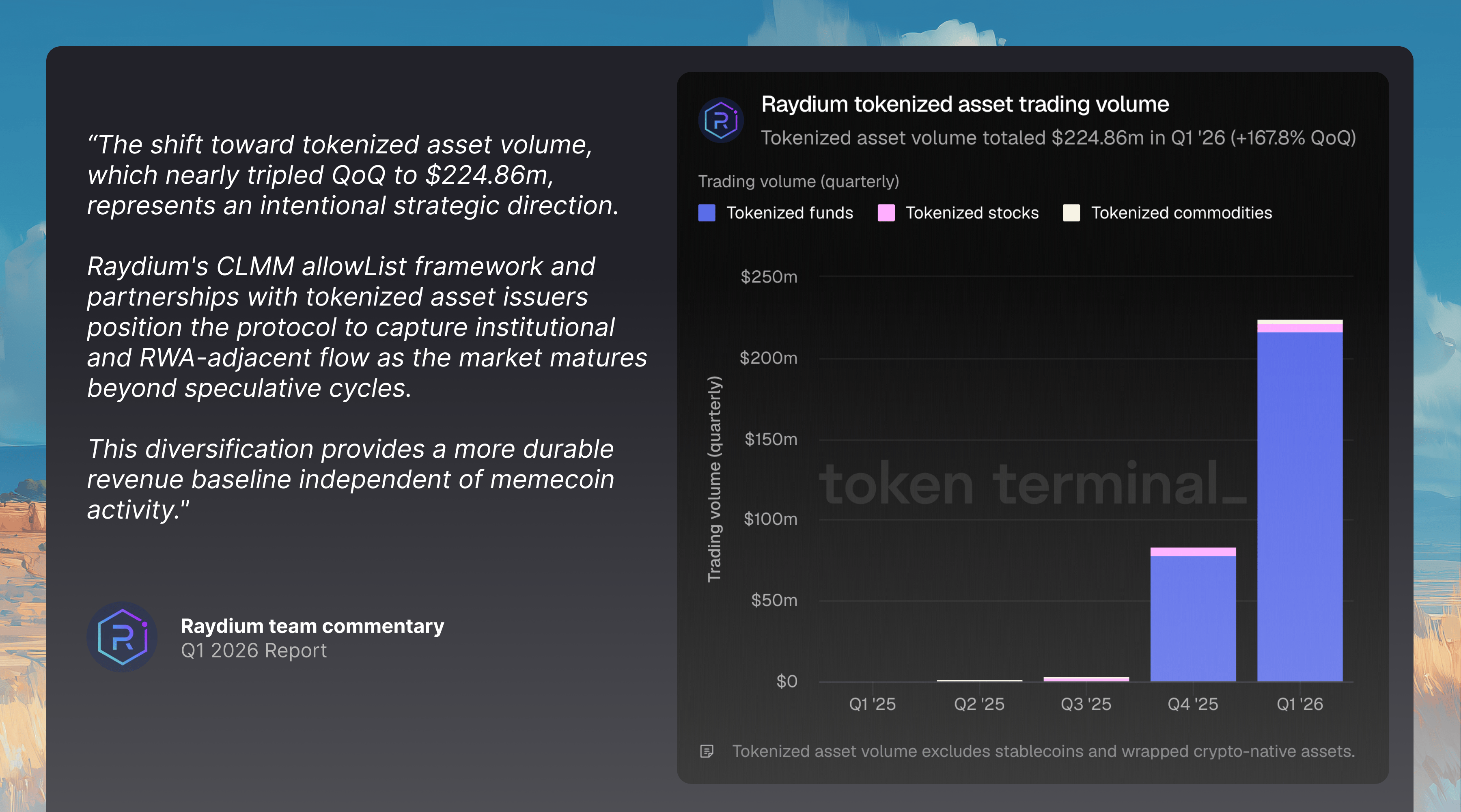
Each report covers key financial and operational metrics alongside qualitative commentary from the respective core team. Additional reports for Q1 2026 are currently in production.
If you're evaluating how to formalize your project's data and reporting strategy, get in touch.

Platform updates:
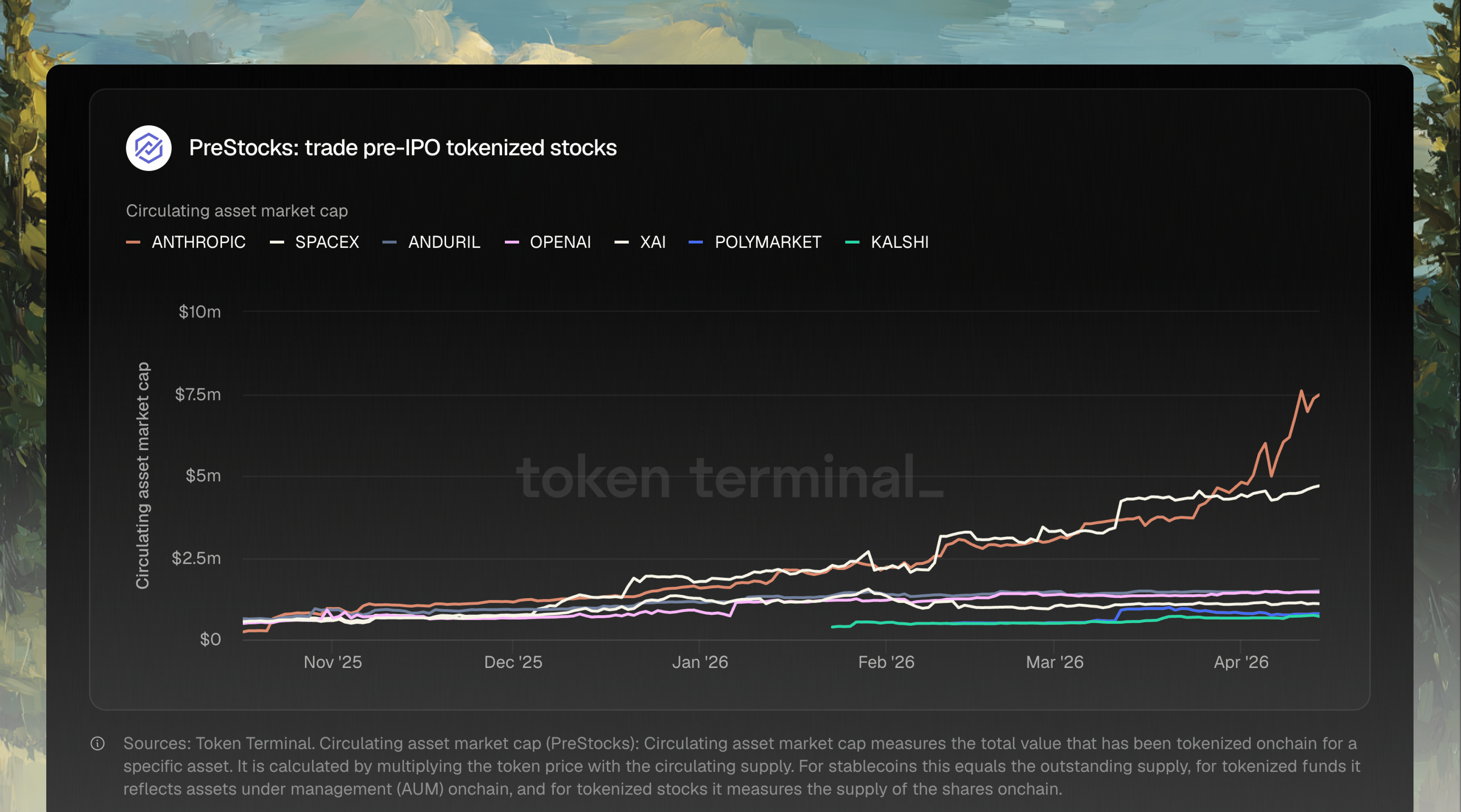
Listed PreStocks, a platform that tokenizes pre-IPO company stocks through SPV-backed Solana tokens, giving users 24/7 access to private companies with no minimums and no management fees. Assets currently tracked: Anduril, Anthropic, Kalshi, OpenAI, Polymarket, SpaceX, and xAI.
Listed Tempo, an L1 blockchain purpose-built for global payments, incubated by Stripe and Paradigm. Available metrics include fees, revenue, earnings, active users, transaction counts, and more.
Listed Sui with a complete set of standardized metrics, covering fees, revenue, earnings, active users, developer activity, transaction counts, and more.
Listed Accountable, Kaspa, Neverland, and Qubic with basic metrics.
Interested in getting listed? Read more here.

The knowledge base behind our agents

Our end-to-end data pipeline runs on nearly 100 skills that produce financial and usage metrics for 100+ blockchains, 1,200+ protocols, and 3,000+ tokenized assets. We describe how we built the skills in our recent engineering blog post, Programming the onchain gigafactory.
Skills tell agents what to do. They do not explain why. When a new chain works differently from what the skill was built for, the agent is likely to copy the pattern and get the output wrong.
The reasoning behind each pattern lived in Notion docs, GitHub PRs, and Slack threads. Inspired by Andrej Karpathy's LLM knowledge base, we decomposed that reasoning into 50+ small, linkable files that sit in the same repository as our skills and pipeline code. Adding the decision files gave agents the reasoning alongside both.
As a result, our agents produce more accurate pull requests on the first pass. An agent reads ~300 tokens of directly relevant reasoning rather than a 2,000-word topic doc. When a new chain works differently, the agent finds the reasoning instead of copying the pattern blind.
We believe this is the fastest path to agents that can run our end-to-end data pipeline autonomously.